
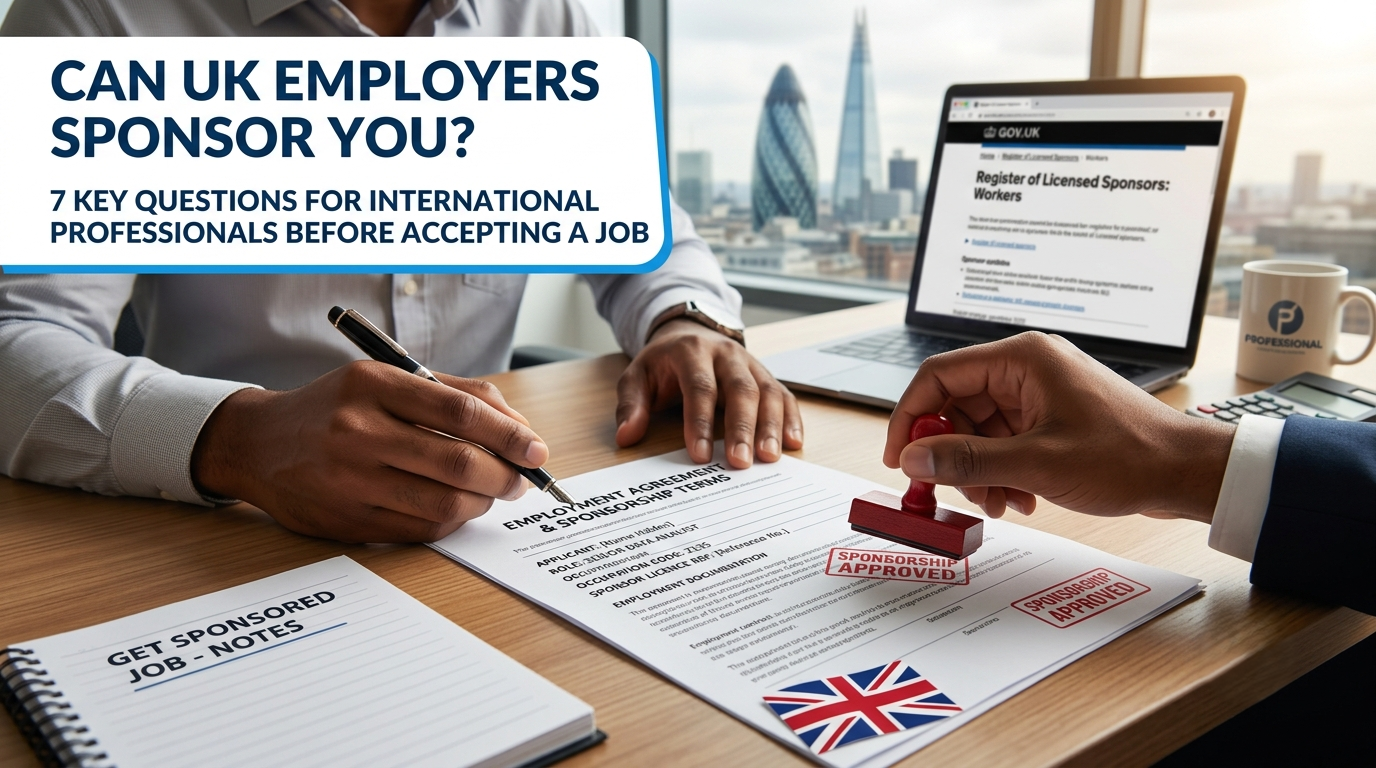
Can UK employers sponsor international workers?
Yes. UK employers can sponsor eligible international workers if they hold the appropriate sponsor licence and the job, salary and worker meet the relevant immigration requirements.
However, being offered a job does not automatically mean you will be sponsored.
Before applying for a job and certainly before accepting an offer international professionals should check whether the employer, role, occupation code, salary and sponsorship timeline are actually suitable for their immigration circumstances.
At Get Sponsored Job, we recommend asking seven key questions.
These questions can help you determine whether a UK job is genuinely capable of leading to sponsorship before you invest significant time in the recruitment process.
1. Is the employer on the UK Register of Licensed Sponsors?
Question to ask:
“Are you currently on the UK Register of Licensed Sponsors, and under which legal entity would I be sponsored?”
A UK employer generally needs an appropriate sponsor licence to sponsor workers through the Skilled Worker route.
You can check the official Register of licensed sponsors: workers on GOV.UK.
However, don’t only search for the company’s trading name.
Large employers can operate through multiple legal entities, subsidiaries and group companies.
You need to establish:
- Whether the employer holds a sponsor licence
- Which legal entity holds the licence
- Whether that entity would employ you
- Whether that entity would issue your Certificate of Sponsorship (CoS)
Why does this matter?
You don’t want to discover after receiving a job offer that the company you interviewed with is not the entity that can actually sponsor you.
Check sponsorship before you become emotionally invested in the opportunity.
2. What occupation code will my Certificate of Sponsorship use?
Question to ask:
“Which occupation code would you use for my Certificate of Sponsorship?”
This is one of the most important sponsorship questions.
UK work visas use occupation codes to classify jobs.
The occupation code should reflect the actual duties and responsibilities of the role, rather than simply the job title.
For example, two jobs can have similar titles but very different responsibilities and therefore fall under different occupation codes.
What should you do?
Ask the employer:
“Can you confirm which occupation code this role would be sponsored under and that the duties of the position match that code?”
If HR or the hiring manager cannot tell you the occupation code, that doesn’t automatically mean the employer cannot sponsor you.
But it does mean you should investigate further.
If nobody has considered the occupation code, you could potentially receive a job offer before discovering that the proposed role does not meet the relevant sponsorship requirements.
The job title is not enough. The duties matter.
3. Is the occupation code eligible for sponsorship under the relevant immigration rules?
Question to ask:
“Is this occupation code currently eligible for sponsorship under the relevant Skilled Worker rules?”
This is particularly important because UK immigration rules and eligible occupation lists can change.
Some occupations may qualify under different provisions, including where an occupation appears on a temporary list.
For example, the Temporary Shortage List is relevant to certain occupations and has specific rules attached to it.
If your eligibility depends on a temporary provision, you need to understand:
- Why the occupation is currently eligible
- How long that eligibility is expected to last
- Whether the rules could affect your future visa position
- Whether the route has restrictions on dependants
Why do dependants matter?
If you are moving to the UK with a spouse or children, your immigration strategy is not just about whether you can get a job.
You also need to ask:
“Will this immigration route allow my eligible dependants to accompany or join me?”
This is something you should establish before accepting the role, not after.
4. What is the guaranteed basic salary?
Question to ask:
“What guaranteed basic salary will be stated in my employment contract and sponsorship documentation?”
This is where international job seekers can make a costly mistake.
Don’t focus only on:
- Total package
- Bonuses
- Commission
- Overtime
- Benefits
- Potential earnings
You need to understand the guaranteed salary and how it compares with the salary requirements that apply to your particular occupation and visa circumstances.
Under the current Skilled Worker rules, the standard salary threshold is generally £41,700, although different salary provisions can apply depending on factors such as the occupation and whether you qualify under a discounted route such as the new entrant provisions.
The relevant going rate for the occupation can also matter.
So ask three questions:
What is my occupation code?
What is the applicable salary requirement?
What guaranteed basic salary will I receive?
Don’t build your immigration strategy around a bonus that isn’t guaranteed.
5. When will my Certificate of Sponsorship be issued?
Question to ask:
“When will you issue my Certificate of Sponsorship?”
This question becomes particularly important if you are already living and working in the UK on another visa.
Your current visa expiry date matters.
You need to understand the timeline between:
Job offer → sponsorship process → Certificate of Sponsorship → visa application → visa decision
Do not assume that receiving a job offer automatically gives you the right to continue working.
Your immigration status and the timing of your application matter.
Why should you ask this before accepting?
Because an employer may genuinely intend to sponsor you but have internal processes that take time.
If that delay interacts with the expiry of your current immigration permission, you could face a serious problem.
Your visa expiry date should therefore be part of the conversation before you accept the offer.
If you may need to apply from outside the UK, that also needs to be considered.
For individual immigration circumstances, always check the current GOV.UK rules or obtain advice from a regulated immigration professional.
6. Who is responsible for sponsorship inside the organisation?
Question to ask:
“Who internally is responsible for managing my sponsorship process?”
This question can save you a lot of unnecessary stress.
One of the biggest problems international candidates encounter is a disconnect between the hiring manager and HR.
A hiring manager might say:
“Yes, we can sponsor you.”
You accept the offer.
Then HR becomes involved and says:
“We need to check whether we can sponsor this position.”
Now you have a problem.
The candidate thought sponsorship had already been agreed.
The hiring manager thought HR would deal with it.
HR didn’t know the conversation had happened.
And suddenly an offer that appeared straightforward becomes complicated.
What should you look for?
You want to know:
- Who owns the sponsorship process?
- Is it HR?
- Is it an internal immigration team?
- Is there an external immigration adviser?
- Has the relevant person been informed about your offer?
- Has the sponsorship requirement actually been approved?
Don’t rely solely on the hiring manager’s verbal reassurance.
Make sure the people responsible for sponsorship are aligned.
7. Will the sponsorship commitment and timeline be confirmed in writing?
Question to ask:
“Can the sponsorship commitment and expected timeline be confirmed in writing as part of my offer?”
This is one of the most important questions you can ask.
Verbal reassurance is useful.
Written confirmation is better.
If an employer says:
“Don’t worry. We’ll sponsor you.”
Ask for clarity around what that actually means.
Ideally, you want written confirmation of:
- The fact that sponsorship has been agreed
- The relevant role
- The expected sponsorship process
- Who is responsible for managing it
- The anticipated timeline
Written confirmation does not guarantee that your visa will be granted.
It also does not replace the formal immigration process.
But it gives you much greater clarity about what the employer has actually agreed to do.
When Should You Ask About Sponsorship?
One of the biggest mistakes international professionals make is waiting until they have a job offer.
You should start thinking about sponsorship before you apply.
Use a three-stage strategy.
Stage 1: Before applying
Research the employer and the role.
Check:
- Is the employer a licensed sponsor?
- Which legal entity holds the licence?
- Is the role potentially eligible?
- What occupation code could apply?
- What salary is likely to be required?
- Does the role work with your current visa situation?
- Are there dependant implications?
This helps you decide whether the opportunity is worth pursuing.
Stage 2: During the recruitment process
Once there is genuine interest from the employer, establish whether sponsorship is possible.
You can say:
“As I require Skilled Worker sponsorship, could you confirm whether this role is eligible for sponsorship and whether the organisation is able to sponsor the position under the appropriate occupation code?”
This is a professional question.
You are not asking an employer to do you a favour.
You are determining whether there is a viable employment and immigration pathway.
Stage 3: Before accepting the offer
This is when you need the details.
Before saying yes, make sure you have clarity on the seven questions:
The 7 UK Sponsorship Questions
1. Is the employer on the Register of Licensed Sponsors?
2. Under which legal entity will I be sponsored?
3. What occupation code will my Certificate of Sponsorship use?
4. Is that occupation code currently eligible under the relevant immigration rules?
5. What is my guaranteed basic salary and does it meet the applicable salary requirements?
6. When will my Certificate of Sponsorship be issued and who is responsible for the process?
7. Will the sponsorship commitment and timeline be confirmed in writing?
The Biggest Mistake International Job Seekers Make
Here is the mindset shift I want international professionals to make:
Stop asking only, “Can this company sponsor me?”
That question is too broad.
Instead ask:
“Can this employer sponsor this specific role, under this specific occupation code, at this specific salary, within the timeframe I need?”
That is the real question.
Because an employer can be a licensed sponsor and still not be able to sponsor you for the particular role you are applying for.
A company can want to hire you and still have a sponsorship problem.
A hiring manager can tell you they will sponsor you and HR may not have approved it.
You can receive a job offer and still discover that the salary or occupation code doesn’t work for your immigration circumstances.
A job offer is not the same thing as a viable sponsored job.
Your UK Sponsored Job Due-Diligence Checklist
Before accepting a UK job as an international professional, check:
☐ Employer is on the Register of Licensed Sponsors
☐ Correct legal sponsoring entity identified
☐ Occupation code identified
☐ Job duties match the occupation code
☐ Occupation is currently eligible under the relevant immigration rules
☐ Applicable salary requirement understood
☐ Guaranteed basic salary confirmed
☐ Current visa expiry date considered
☐ Certificate of Sponsorship timeline confirmed
☐ Internal sponsorship contact identified
☐ Sponsorship commitment confirmed in writing
☐ Dependant implications checked, if relevant
If you cannot answer these questions, you don’t yet have enough information to make an informed decision about the job.
Final Thought: Don’t Just Find a Job. Find a Viable Sponsorship Opportunity.
For international professionals, the goal isn’t simply to find a UK employer that is hiring.
The goal is to find a role that works for your career, your immigration circumstances and your future.
That means doing your sponsorship due diligence before you spend weeks chasing an opportunity that may never work.
At Get Sponsored Job, we help international professionals move from:
“I need a sponsored job.”
to:
“I know which roles to target, which employers to approach, how to position myself and how to navigate the sponsorship conversation.”
Because the smartest sponsored job search doesn’t start with:
“Who is hiring?”
It starts with:
“Which sponsored roles are realistically viable for me and how do I become the candidate that employer wants to sponsor?”
Frequently Asked Questions
Yes. UK companies can sponsor eligible international workers if they hold the appropriate sponsor licence and the job and worker meet the relevant immigration requirements.
Check the official UK Register of Licensed Sponsors and then establish whether the specific role is eligible, which occupation code would be used and whether the salary meets the applicable requirements.
Potentially, but receiving a job offer does not automatically mean sponsorship is available. The employer, role, occupation code, salary and your immigration circumstances must all be considered.
An occupation code is the classification used to identify the type of work being sponsored. The code should correspond with the actual duties of the role rather than simply the job title.
The applicable salary depends on your circumstances, occupation and the relevant immigration rules. The standard salary threshold is currently £41,700 in many cases, but exceptions and discounted provisions can apply.
It depends on the immigration route and occupation. Certain roles and routes have restrictions on dependants, so international professionals should check this before accepting an offer.
Your options depend on your individual immigration circumstances and the timing of your application. Do not assume that a job offer automatically allows you to remain and work in the UK. Check the current GOV.UK rules and seek regulated immigration advice where appropriate.
Yes. Ideally, you should research sponsorship eligibility before applying. This can prevent you from investing significant time in jobs that are unlikely to provide a viable sponsorship pathway.
Important: UK immigration rules change frequently. The information in this article is intended as general career and sponsorship guidance, not immigration advice. Always check the latest requirements on GOV.UK or speak to a regulated UK immigration adviser about your individual circumstances.
