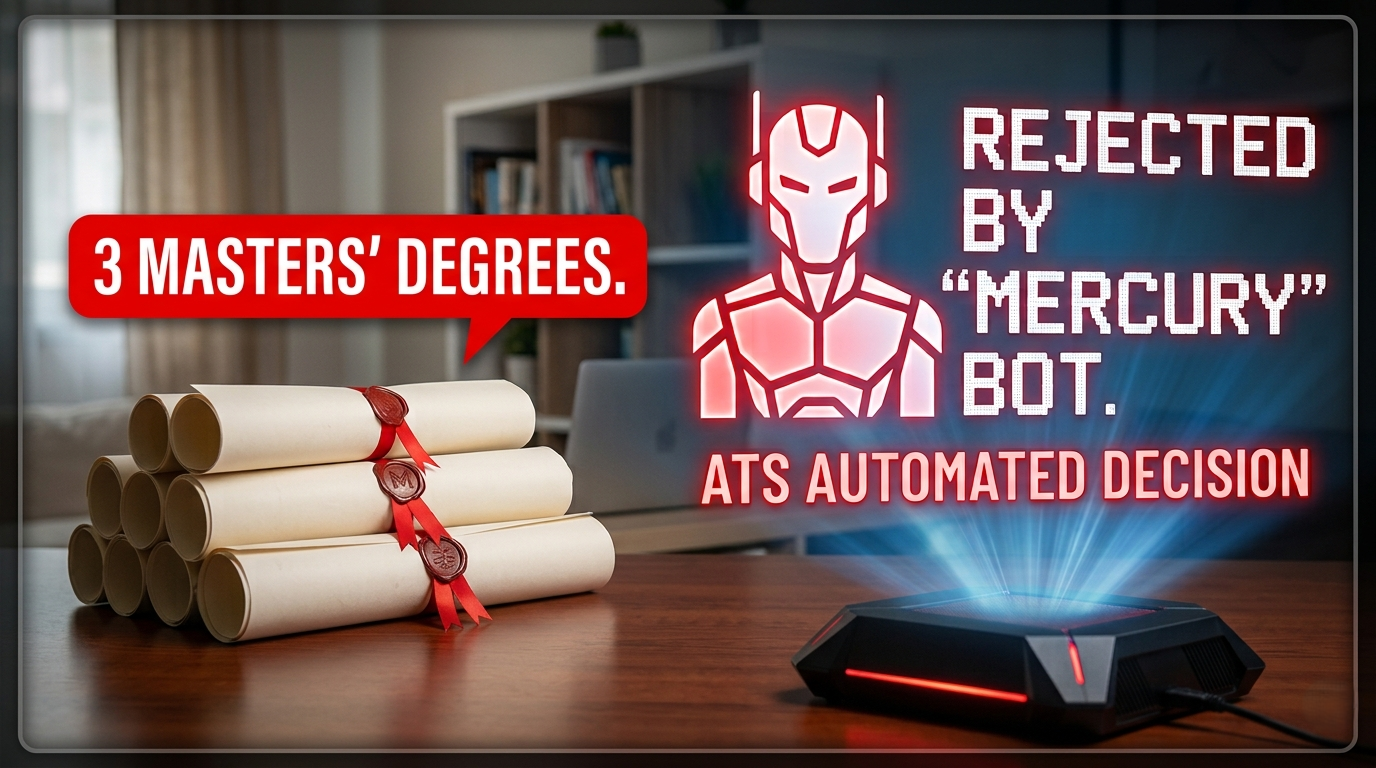
Somewhere in a server room, possibly in Croydon, an algorithm with the emotional range of a toaster has just decided your PhD doesn’t count. You’ve been rejected in 0.4 seconds by software that cannot feel joy, disappointment, or the mild panic you’re currently experiencing.
Here’s what nobody’s telling you. The ATS isn’t smart enough to reject you for being unqualified. It’s parsing software. It extracts text, matches keywords, and organises data into fields a human will later read. It does not “score your potential” or judge your life choices. Most of what candidates believe about ATS is folklore passed around job search forums by people who also think a LinkedIn “profile view” means someone’s about to hire them.
The Twist Nobody’s Talking About
Because everyone’s now terrified of the robot, they’ve overcorrected. CVs arrive stripped of personality, buried in keyword soup, formatted like a legal disclaimer, completely unreadable to the actual human who opens it 30 seconds later. Congratulations, you beat the bot and lost the person.
You are not being screened by one gatekeeper. You’re being screened by two, and they want different things.
An Example of Overcorrection in Action
One candidate applying for a project coordinator role rewrote every single bullet point to cram in the phrase “stakeholder management” five times, because it appeared once in the job ad. The CV passed the ATS. The human reviewer read it and moved on in eight seconds, because it read like a keyword list, not a person. A better version used “stakeholder management” once, accurately, in context: “Managed relationships with 6 external stakeholders across procurement and finance, resolving contract delays two weeks ahead of deadline.” Same keyword, completely different result.
What the ATS Actually Needs
- Standard section headings. “Work Experience,” not “My Journey.” “Education,” not “Where I Learned Things.”
- No tables, columns, text boxes, or graphics. Most parsers choke on these and either scramble your content or drop it entirely. Example: a two column CV with skills in a sidebar often gets read top to bottom across both columns, turning “Project Management” and “2019 to 2021” into unreadable nonsense in the parsed text.
- PDF or DOCX only, unless the job ad specifies otherwise. Never DOC, never an image file, never a CV designed in Canva and exported as a flattened image.
- Keywords lifted from the actual job description, exact phrasing, not synonyms. If the ad says “stakeholder management,” don’t write “liaised with key parties.” If the ad says “Power BI,” don’t write “data visualisation tools.”
What the Human Needs (And Why You Can’t Skip This)
Once your CV clears the parser, a real person reads it, usually for six to eight seconds on the first pass. If it’s a wall of stuffed keywords with no narrative, no achievements, no numbers, they move on. Humans want:
- A clear one line summary of who you are and what you’re targeting
- Achievements with outcomes, for example “reduced onboarding time by 30 percent,” not just duties like “responsible for onboarding”
- Readable formatting: white space, consistent bullet structure, no 9pt font crammed to fit one page
The Fix: Format for the Bot, Write for the Human
Structure and headings satisfy the ATS. Voice, achievements, and clarity satisfy the recruiter. You need both running in the same document, not a keyword stuffed version for the robot and a “real” version for humans. One CV, two audiences, same document.
Before and After
Before: “Responsible for management of team and cross-functional collaboration to drive results.” After: “Led a team of 6 and coordinated with product and design to cut project delivery time by 20 percent.”
Another example, before: “Handled customer queries and provided support in a fast-paced environment.” After: “Resolved an average of 40 customer queries daily, maintaining a 95 percent satisfaction rating over 6 months.”
Same skill in both pairs. One version is invisible. One gets a phone call.
The Bottom Line
Your three masters degrees aren’t the problem. A CV formatted to survive the parser but written for nobody in particular is. Fix the format first, then fix the voice.
