
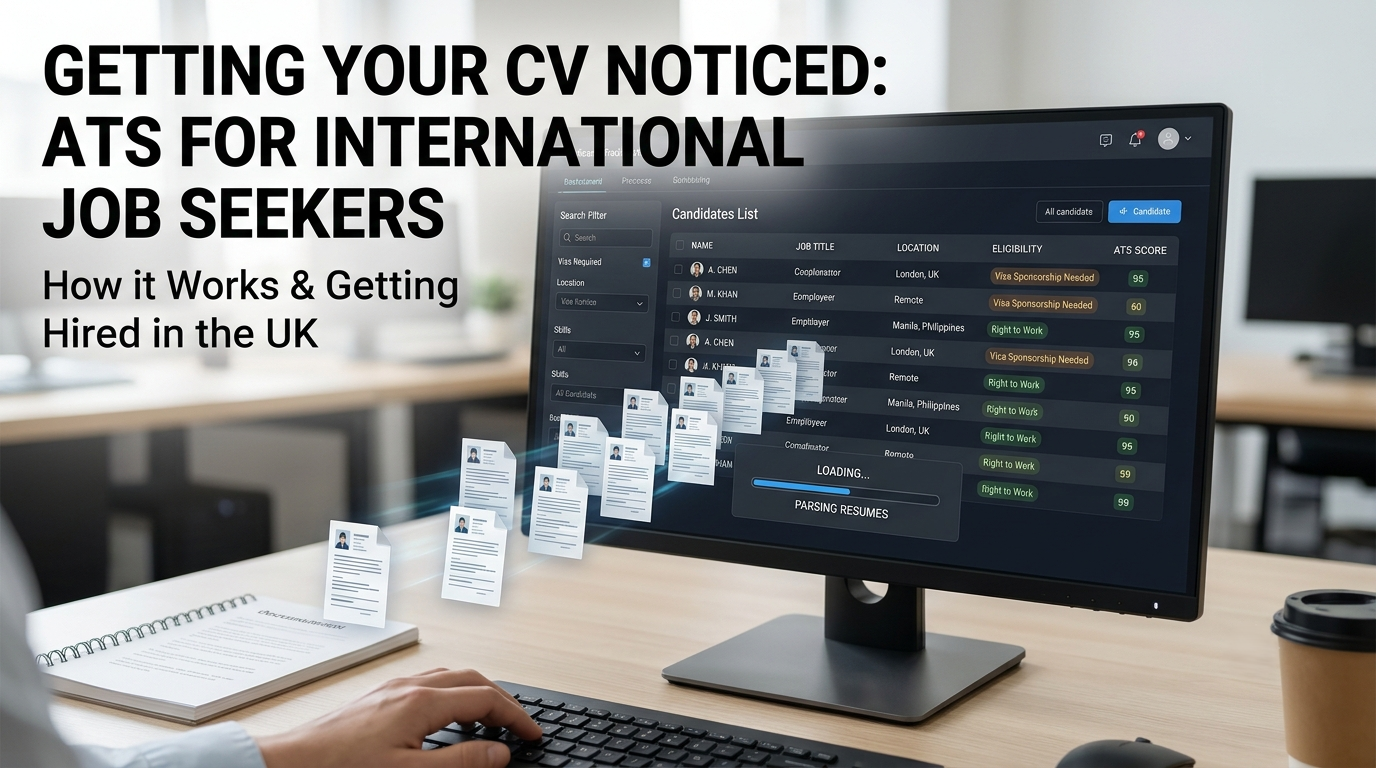
You have applied for 60 jobs. You have heard back from three.
One was an automated email thanking you for your interest. Which is corporate language for: we have received your application, but you may never hear from us again.
Someone has probably told you the reason is the ATS. A robot. A cold, merciless algorithm that scans your CV for 0.3 seconds and throws it away because you used the wrong font.
Having worked on the recruitment side of UK hiring, I want to tell you something that might surprise you: your CV is probably not being rejected for the reason you think.
Sometimes it is a sponsorship eligibility issue. Sometimes your experience is difficult to find, your CV does not communicate the skills the employer needs. And sometimes, quite simply, a recruiter has more applications than time.
Understanding the difference matters, particularly if you are an international professional trying to secure a job in the UK.
Let’s separate ATS myths from recruitment reality and look at what you can actually do to improve your chances.
What Is an ATS? (The Plain English Explanation)
ATS stands for Applicant Tracking System. It is software employers use to collect, organise, manage and track job applications.
Think of it as a very organised digital filing cabinet.
Instead of receiving hundreds of CVs through email and manually organising every application, recruiters use an ATS to manage candidates throughout the hiring process.
You have probably encountered systems such as:
- Workday
- Oracle Taleo
- Greenhouse
- SmartRecruiters
- Lever
- iCIMS
- NHS Jobs
Each platform works differently, but the general purpose is similar.
An Applicant Tracking System can:
- Collect CVs, cover letters and application forms.
- Extract information such as employment history, qualifications, contact details and skills.
- Record answers to screening questions.
- Help recruiters search applications using job titles, skills and keywords.
- Organise candidates by application stage.
- Support screening, ranking and reporting.
Some modern recruitment platforms also incorporate artificial intelligence to summarise applications, identify relevant experience or assist with candidate screening.
However, here is the important distinction: an ATS is not necessarily an automatic rejection machine.
The system may organise your application, help rank candidates or apply employer-defined screening criteria. A recruiter may still make the decision.
Why International Job Seekers Need to Understand ATS
If you are applying for jobs from outside the UK, the recruitment process has additional complications.
You are not simply competing on experience and qualifications. You may also need to demonstrate that your immigration circumstances align with the employer’s requirements.
There are three particular challenges.
1. Your right-to-work and sponsorship answers matter
UK employers commonly ask whether you have the right to work in the UK and whether you will require sponsorship now or in the future.
These questions are important because an employer may have configured its recruitment system to filter applications based on eligibility.
For example, if an organisation cannot sponsor workers and you indicate that you require Skilled Worker sponsorship, your application may be automatically declined.
This is not necessarily a CV problem. It may be an employer eligibility problem.
2. Your CV may be written for a different recruitment market
CV conventions vary between countries.
You might have a photograph, date of birth, personal information, multiple columns or a detailed personal statement because those conventions are familiar in your home country.
However, UK recruiters generally expect a more concise, achievement-focused CV.
The issue is not that your international experience is less valuable. It is that your experience needs to be presented in a way that UK employers can understand.
We explain this further in our guide, Recruiters Don’t Reject Your CV. They Reject the Story It Tells.
3. You have less room for wasted applications
When you need sponsorship, applying indiscriminately is an expensive use of time.
You need to identify suitable employers, understand the vacancy requirements and position your experience against the role.
Sending the same CV to 60 employers is not necessarily a better strategy than sending 15 carefully targeted applications.
The objective is not to apply everywhere. It is to become a credible candidate for the right opportunities.
Does ATS Automatically Reject 75% of CVs?
This is one of the most frequently repeated claims in job-search advice.
You will find it in LinkedIn posts, CV-writing websites and videos promising to help you beat the ATS.
The problem is that the widely repeated 75% figure does not have a clearly established, credible evidence base.
There is, however, some interesting recruiter research.
In a 2025 study published by Enhancv, 25 US-based recruiters were interviewed about how their applicant tracking systems operate.
Twenty-three of the 25 recruiters (92%) said their systems did not automatically reject CVs based on formatting, content or design. Two recruiters (8%) reported using content-based automatic rejection.
The study also found that knockout questions were commonly used to screen for essential requirements.
There is an important caveat: 25 recruiters is a small sample, and the research focused on US hiring rather than the UK market. It should not be treated as a definitive picture of every employer’s recruitment process.
Nevertheless, it challenges the idea that most CVs are automatically deleted because of formatting mistakes.
The more useful takeaway is this:
- Your CV can be difficult for a system to interpret.
- Your application can rank poorly against other candidates.
- An employer can automatically filter you out based on a mandatory requirement.
- A recruiter can decide not to progress your application.
These are different situations, and each requires a different solution.
How an ATS Works: The Four Gates Your CV Must Pass
Understanding the four stages helps you identify where your applications might be going wrong.
Gate 1: Knockout questions
These are screening questions employers use to establish whether candidates meet essential requirements.
Examples include:
- Do you have the right to work in the UK?
- Will you require visa sponsorship now or in the future?
- Do you hold the required professional registration?
- Are you able to work at the advertised location?
- Do you have the minimum experience required?
Some employers configure their systems to reject applications automatically when candidates do not meet specific requirements.
For international candidates, sponsorship is particularly important.
What should you do?
Answer every question honestly. Never claim that you do not require sponsorship if you know you will need it.
Misrepresenting your immigration circumstances can create serious problems during right-to-work checks and at offer stage.
Instead, check the UK Register of Licensed Sponsors and identify organisations that hold an appropriate sponsor licence.
Remember, being listed does not guarantee that an employer will sponsor every vacancy. You must also check whether the role is suitable and whether the employer is willing to sponsor for that particular position.
Gate 2: CV parsing
Parsing is the process of extracting information from your CV and organising it into fields that the recruitment system can recognise.
Imagine uploading a beautifully designed CV with two columns, icons, graphics and contact information inside a header.
A human might find it attractive. However, depending on the system and file format, the software may struggle to interpret the information in the correct order.
Your employment history could become confusing. Your contact details might not be extracted properly. And your skills might appear in the wrong section.
This does not mean every two-column CV will fail. Modern systems vary considerably.
But a straightforward, text-based layout reduces unnecessary risk.
What should you do?
Use clear headings, consistent formatting and readable text. Keep your contact details in the main body of the document and avoid relying on graphics to communicate important information.
Gate 3: Ranking and relevance
This is where your experience needs to match what the employer is looking for.
Suppose a vacancy repeatedly mentions:
- Stakeholder management
- Project governance
- Risk management
- Budget reporting
- Cross-functional collaboration
Your CV describes the same experience using different terminology.
You might have performed exactly the work required, but the relevant evidence is difficult to identify.
Some recruitment systems support keyword searches, matching features and candidate ranking. Others rely more heavily on recruiter searches and manual screening.
Either way, the underlying principle remains the same: make your relevant experience easy to find.
Use the employer’s terminology where it accurately reflects your work.
Do not copy the job description into your CV or add skills you do not possess.
A keyword without evidence is just a claim.
Gate 4: The human recruiter
Eventually, someone may review your application.
This is where your professional story matters.
Can the recruiter understand your experience quickly? Do your achievements demonstrate impact? Is your previous experience relevant to the vacancy? Can you explain how your skills transfer to the employer’s environment?
For international candidates, this is particularly important.
Your CV should not simply list responsibilities. It should show what you achieved, how you achieved it and why that experience matters to the employer.
A CV that is easy to parse but difficult to understand is still a weak CV.
Five Realistic ATS Scenarios International Candidates Should Understand
The following composite examples illustrate common recruitment situations. Names and details are illustrative, not identifiable candidate case studies.
Scenario 1: Rejected because of sponsorship eligibility
Arjun is a data analyst currently in the UK on a Student visa. He applies for an analyst position and answers honestly that he will require sponsorship.
The employer does not hold an appropriate sponsor licence and has configured its application process to filter out candidates requiring sponsorship.
His application is declined.
The lesson: This is not a formatting issue. Arjun needs to prioritise suitable sponsoring employers and vacancies.
Scenario 2: Buried because of keyword mismatch
Mei has five years of project coordination experience in Singapore.
The vacancy asks for stakeholder management, risk registers and project governance. Her CV describes client liaison, issue tracking and project oversight.
Her experience is relevant, but the connection is not immediately obvious.
The lesson: Use the employer’s terminology where it truthfully describes your experience. Make your transferable skills visible.
Scenario 3: Difficult to read because of formatting
Tunde is a software developer with strong technical experience. His CV uses two columns, graphics and skill-rating bars.
The system does not extract his information accurately, leaving an incomplete candidate profile.
The lesson: Prioritise clear formatting and test whether your document’s text can be selected and copied in the correct reading order.
Scenario 4: Missing a mandatory professional qualification
Fatima is an overseas-trained nurse applying for a UK nursing position.
The vacancy requires current NMC registration. Fatima has started the registration process but has not yet received confirmation.
She answers that she does not currently hold registration and is filtered out.
The lesson: Understand the difference between a qualification you hold and one you are working towards. Check whether the employer accepts candidates whose registration is in progress.
Scenario 5: Reaches the recruiter through strong positioning
Priya has marketing experience and is targeting UK employers that may be able to sponsor her.
She checks employer eligibility, answers application questions honestly and submits a clear CV tailored to the vacancy.
Her achievements include measurable results, relevant campaign experience and the tools she has used.
The recruiter can quickly understand her suitability.
The lesson: Priya has not beaten the ATS. She has made her application easier to understand, assess and progress.
How to Create an ATS-Friendly CV for UK Employers
Here is a practical checklist for international job seekers.
CV layout and formatting
- Use a clear, straightforward layout. A single-column format is a sensible starting point.
- Include your name, phone number, email address, location and LinkedIn profile.
- Use standard headings such as Professional Summary, Work Experience, Education, Skills and Certifications.
- Choose a readable font such as Arial, Calibri or Helvetica.
- Avoid unnecessary graphics, skill bars and complex text boxes.
- Use a text-based PDF or Word document, following the employer’s specified file requirements.
- Give your file a professional name, such as FirstName-LastName-CV.docx.
UK CV conventions
- Generally avoid photographs, date of birth and marital status.
- Aim for approximately two pages, adjusting for your experience and seniority.
- List employment history in reverse chronological order.
- Use consistent dates, job titles and employer information.
- Use British English where appropriate, including words such as organised, programme and analyse.
Keywords and achievements
- Read the vacancy carefully and identify repeated skills, qualifications and responsibilities.
- Use relevant keywords naturally when they accurately describe your experience.
- Include both full terms and abbreviations where useful, such as Search Engine Optimisation (SEO).
- Demonstrate skills through achievement-based examples.
- Include measurable results wherever possible.
- Never hide keywords in white text or claim skills you do not have.
For example, instead of writing:
“Responsible for weekly reporting.”
Write:
“Developed automated reporting processes that reduced weekly reporting time from six hours to 40 minutes.”
The second example communicates the skill, the action and the result.
Application strategy
- Check whether the employer holds an appropriate sponsor licence.
- Read the vacancy carefully for sponsorship restrictions.
- Answer all immigration and eligibility questions truthfully.
- Tailor your CV to the vacancy rather than sending the same document everywhere.
- Apply promptly when a suitable vacancy is advertised.
- Where appropriate, contact the recruiter or hiring manager professionally after applying.
What About AI Recruitment and Your Rights in the UK?
Recruitment technology is evolving.
Employers increasingly use automation and AI to support CV screening, candidate assessments and recruitment decisions.
The Information Commissioner’s Office (ICO) published findings on automated recruitment decisions on 31 March 2026, following engagement with more than 30 employers.
Its findings highlighted the importance of transparency, fairness, appropriate safeguards and consistent human involvement where employers use automated decision-making.
The Data (Use and Access) Act 2025 also updated UK data protection legislation relating to automated decision-making.
For job seekers, the practical message is straightforward:
- Employers should provide appropriate information about how automated decision-making is used.
- Automated recruitment decisions must comply with applicable data protection requirements.
- Safeguards and fairness matter.
- Candidates may have rights to challenge certain automated decisions and request human review.
If you are concerned about how an employer has assessed your application, you can consult the ICO’s guidance on automated recruitment decisions.
Frequently Asked Questions
ATS stands for Applicant Tracking System. It is software employers use to collect, organise and manage job applications.
Some employers configure automatic screening or rejection rules. However, not every ATS automatically rejects CVs based on formatting or missing keywords. Practices vary between employers.
It may happen if an employer has configured sponsorship requirements as a screening condition. Target suitable sponsoring employers and answer all questions honestly.
A clearly structured, text-based document with standard headings and readable formatting is a sensible choice. Follow the employer’s file requirements.
Follow the vacancy instructions. If no preference is stated, a .docx file or text-based PDF is generally a practical option.
There is no universal ideal number. Include the relevant skills and terminology that accurately reflect your experience. Avoid keyword stuffing.
You must answer based on your actual immigration circumstances and future sponsorship requirements. Having current permission to work does not automatically mean you will never require sponsorship.
You do not need to rewrite your CV from scratch. Maintain a strong master CV and tailor your professional summary, relevant skills and achievement examples to each suitable vacancy.
Possible reasons include sponsorship restrictions, insufficient evidence of relevant skills, competition, application timing and how your experience is positioned. An ATS-friendly format is only one part of a successful application.
Yes, depending on the role, employer and candidate’s skills. The important thing is to demonstrate relevant experience, transferable skills and evidence of your ability to deliver results. Our guide to skills-based hiring and building employer-trusted evidence explains this further.
The Bottom Line: Stop Trying to Beat the ATS. Start Becoming the Candidate Employers Can Find.
The ATS is not your enemy. But it is not going to make your application successful either.
If you are an international professional targeting the UK, your job search needs to be more strategic.
Focus on four things:
- Eligibility: Identify employers and vacancies that are suitable for your immigration circumstances.
- Readability: Make your CV easy for recruitment systems and people to understand.
- Relevance: Demonstrate the skills and experience the employer actually needs.
- Evidence: Show measurable achievements that give recruiters a reason to progress your application.
And remember: an ATS-friendly CV cannot compensate for applying to employers who cannot sponsor you. Equally, finding a licensed sponsor will not help if your CV fails to communicate your value.
Both sides of the equation matter.
Not sure why your UK job applications are not getting responses?
You may not need another CV template. You may need to understand where your job-search strategy is going wrong.
At Get Sponsored Job, we look beyond CV formatting.
We examine your professional profile, experience, job targeting, sponsorship strategy and how effectively you communicate your value to UK employers.
Our profile audit helps identify the gaps that could be preventing you from progressing and the practical changes worth prioritising.
You can also explore the Get H.I.R.E.D in UK/EU Challenge if you want a more structured approach to your international job search.
Because the objective is not to send more applications.
It is to make the right applications count.
