
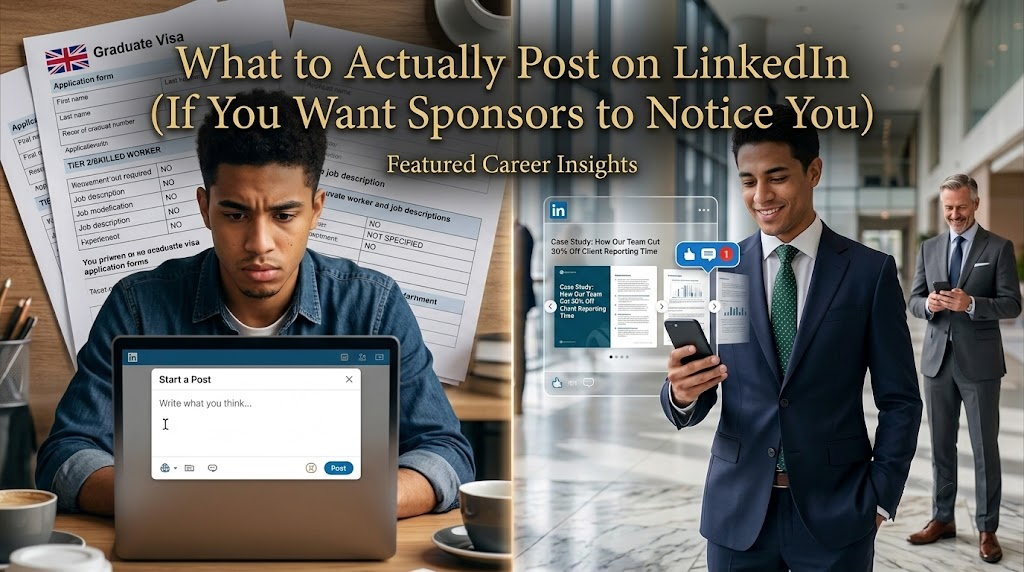
The Problem: You Have a LinkedIn Profile. You Just Have Nothing to Say.
Here is the scene. You are on a Graduate or Student visa. You know you need to be “active on LinkedIn.” Everyone says so. So you log in, stare at the blinking cursor, and then close the tab and go back to job boards. Sound familiar?
This is one of the most common traps international professionals fall into. They have optimised their profile. They have written a decent headline. But when it comes to actually posting content, they freeze. And so the profile sits there, quietly doing nothing.
The problem is not that you have nothing to say. The problem is that no one has ever told you what to say, in what order, with what goal in mind.
Why This Is Costing You Sponsored Roles
LinkedIn is not just a digital CV anymore. LinkedIn’s activity now affects profile visibility even in passive search. Recruiters searching for candidates see more active profiles first. That is not an opinion from a career coach. That is how the platform’s algorithm is now built.
If you are not posting, you are invisible. Not just to your connections, but to the recruiters actively searching for candidates with your skill set right now.
87% of recruiters use LinkedIn to source candidates. The professionals getting inbound messages and interview requests are not always the most qualified. They are the most visible. And visibility in 2026 is built through consistent, relevant content, not a polished static profile.
For international professionals specifically, this matters even more. You are not getting the warm referrals that come from years of networking in the UK market. LinkedIn content is your referral system. It puts you in front of hiring managers before you have even applied. Used correctly, it builds the familiarity and trust that sponsors need to feel before they take a risk on someone who requires a visa.
Why Now Is the Moment to Fix This
In March 2026, LinkedIn’s Authenticity Update officially cracked down on engagement bait, automation pods, and low-quality content. Meanwhile, specific formats are outperforming everything else, with document posts reaching engagement rates of up to 6.6%, the highest of any format on the platform.
LinkedIn’s latest algorithm, known as 360 Brew, now cross-references content topics against the profile’s stated expertise. A person whose profile says they are a healthcare professional who posts about cryptocurrency will see their distribution drop because the platform cannot verify topical authority.
Translation: you cannot just post random inspiration quotes and hope recruiters find you. Your content has to be relevant to your field. And it has to be posted consistently. The window to build this presence before your visa clock ticks louder is right now.
The LinkedIn Content Playbook for Sponsored Job Hunters
Here is your repeatable content framework. You do not need to post every day. A sustainable schedule for most job seekers is two to three posts per week: one educational post, one insight or lesson learned, and one conversation starter. That is it. Three posts. Rotate between these three content types every week.
Content Type 1: The Insight Post (Educational)
Share something you know that others in your field would benefit from. This is not showing off. This is demonstrating professional authority, which is exactly what a sponsor wants to see before they hire someone.
Formula to follow:
- Open with a specific, surprising or counterintuitive statement (your hook)
- Share the insight in 3 to 5 short paragraphs, using your own experience or professional knowledge
- End with a question to invite responses
Example for a data analyst: “Most dashboards I have reviewed show the right data but in the wrong order. Here is how I restructured a reporting layout that cut stakeholder confusion by half…”
Content Type 2: The Experience Post (Story-Based)
Insights and lessons from real work experience consistently outperform generic motivational content. A post about a specific project, a hard-won lesson, or a career pivot reaches further than anything vague.
Formula to follow:
- Set the scene in one sentence (where, what, when)
- Describe the challenge or turning point
- Share what you learned or what changed
- Connect it to something useful for your reader
This format works especially well for international professionals. Your journey has a story in it. The move to a new country, adapting to a different work culture, learning to navigate a new system. These are not weaknesses. They are content.
Content Type 3: The Conversation Starter
Questions that ask the network for input generate the kind of meaningful comments the algorithm prioritises, with specific questions receiving roughly three times more responses than vague prompts like “Thoughts?”
Formula to follow:
- Ask one specific, relevant question to your industry
- Give your own brief perspective first (two to three sentences)
- Invite others to weigh in
Example: “I have seen three fintech job descriptions this week that list ‘Python’ as essential but do not mention the actual use case. What does Python actually mean in your role? I will go first…”
The Format Cheat Sheet
| Format | Best For | Engagement Level |
| Text post (1,000 to 1,300 characters) | Stories and opinions | Strong, high dwell time |
| PDF carousel (document post) | Frameworks, guides, checklists | Highest (up to 6.6% engagement rate) |
| Short native video (under 30 seconds) | Quick insights and personality | Growing fast |
| Poll | Opinions | Largely dead post-March 2026 update |
One non-negotiable: posts containing an off-platform link see roughly 60% less reach. If you need to share a link, create native value first and put the link in the post body only where necessary.
Three Rules That Change Everything
Stay in your lane. Post about your field. If your profile says you are a software engineer, post about software engineering. The algorithm rewards consistency and punishes topic drift.
Write like a person, not a press release. An increasing number of people are using AI to write their posts and it sticks out. People visiting your profile want to find out about you as a person and a professional, not to read a polished but robotic narrative that has no substance.
Engage before you post. Spend five minutes commenting meaningfully on two or three posts in your industry before you publish your own content. This signals to the algorithm that you are an active, relevant participant, not just a broadcaster.
You Already Have More to Say Than You Think
Every week in your professional life, something happens worth sharing. A decision you made. A challenge you overcame. A question you are sitting with. A process you have streamlined. A trend you noticed.
That is your content. You do not need to become an influencer. You need to become visible to the right people, consistently, in your area of expertise.
The professionals getting the sponsorship conversations started on LinkedIn are not necessarily the most experienced. They are the ones who showed up consistently and gave hiring managers a reason to remember them.
If you want a clear strategy for turning that LinkedIn presence into actual sponsored job offers, that is exactly what we work on inside the Get H.I.R.E.D. Challenge. Start there.
